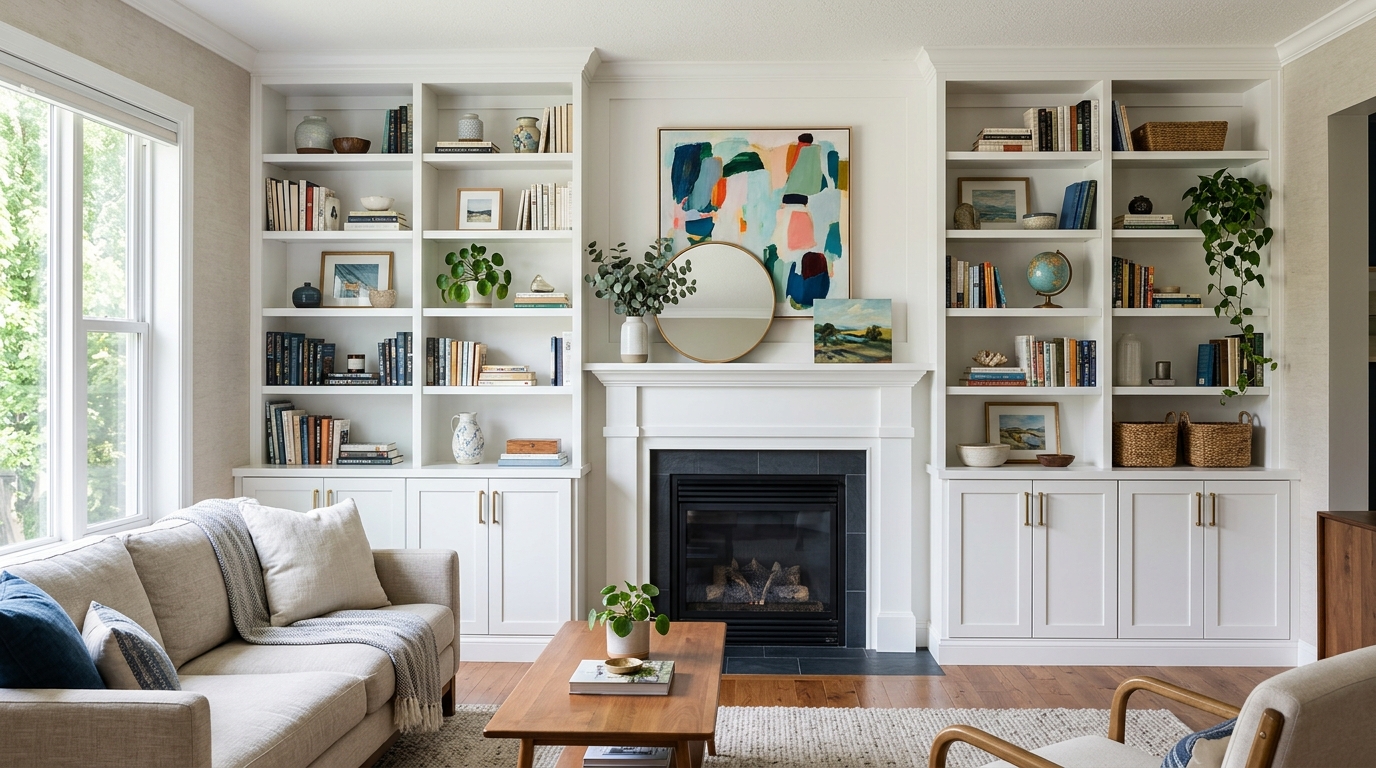
I’ve spent way too many hours staring at my living room wall, wishing it didn’t look so flat. Built-ins should feel like part of the house, not some weird clunky box you stuck there to hide a mess. Most people play it safe. They end up with something that looks like a high school library from the 90s.
Honestly? It’s depressing.
If you’re going to spend the money—and custom work isn’t cheap—you need to make sure it actually does something for the room. I’ve seen enough “safe” white shelves to last a lifetime. Let’s talk about what actually works when you want your home to look like you hired a designer who actually cares.
Go Dark with Charcoal or Moody Navy
Everyone goes for white paint. It’s the “safe” choice that people pick when they’re scared of making a mistake. It’s also incredibly dull. I painted my last set of shelves a color that was basically black, and my neighbor thought I’d spent ten grand on custom millwork.
Dark colors make your stuff pop.
Think about it. A gold frame or a stack of old, beat-up books looks expensive against a charcoal background. If you go with a moody navy, the whole wall recedes and makes the room feel twice as big. It’s a trick that actually works, even if your mother-in-law tells you it’ll make the room feel like a cave. She’s wrong.
The Arch Trend That Actually Stays
I used to think arches were just a phase, like those “Live Laugh Love” signs everyone bought five years ago. I was wrong. Softening the top of a shelf unit keeps the room from looking like a giant box of rectangles. It adds some actual architecture to a boring drywall box.
It’s about the vibe.
You don’t need a master carpenter to do this, either. I’ve seen people do this with flexible drywall and a lot of sanding. It’s a messy weekend, sure, but the result makes your living room look like a custom build instead of an afterthought. Sharp corners are for offices; arches are for homes.
Floating Shelves for a Clean Modern Look
Beefy, chunky shelves are over. If you want that high-end look, you have to go thinner and skip the side supports. I prefer floating ledges that look like they’re just hanging out on the wall by magic. It feels light.
It looks expensive.
Just don’t cheap out on the brackets. I once tried to save twenty bucks on “invisible” supports and ended up with a shelf that sagged the second I put a heavy book on it. Hit the studs. Every. Single. Time. If you don’t, your favorite ceramic vase is going to end up in a million pieces on the floor.
Why Integrated LED Strips are Non-Negotiable
Puck lights are trash. There, I said it. They create those weird, ugly “hot spots” of light that make your shelves look like a cheap retail display at the mall. It’s a look, but it’s a bad one.
You want the glow.
Run thin LED strips in a recessed channel along the back or front edge of the shelf. It’s a massive pain to wire up—I definitely burned a whole Saturday swearing at a transformer once—but it’s worth it. When it’s 8 PM and you turn those on, the whole room transforms. It’s the difference between a house and a “space.”
Wallpapering the Backs for Visual Pop
I used to think plain white backs were “timeless.” I was wrong—they’re just boring. Last spring, I spent six hours wrestling with a roll of navy grasscloth wallpaper (peel-and-stick is a total lie, by the way) and the result was insane. It gives the shelves a depth that paint just can’t touch.
It hides the messy gaps behind your books.
Just make sure you pick a pattern that isn’t too busy. If you go with tiny polka dots, your eyes will start to hurt after ten minutes of sitting on the couch. Trust me on that one.
Embracing Asymmetry to Look Less Stiff
Stop trying to make your house look like a Wes Anderson movie set. It’s weird. Perfect symmetry feels stiff—like you’re living in a showroom where no one is allowed to touch anything. I deliberately offset the shelves in my last project, putting a huge gap on the left for a monster-sized fiddle leaf fig.
It looks way more expensive when it feels “accidental.”
When everything matches perfectly, the room feels dead. Move a shelf up. Move another one down. Leave a big weird space for a piece of art that doesn’t fit anywhere else. It works.
Going Floor to Ceiling for Massive Impact
Most people stop their built-ins a foot from the ceiling. Why? To save a few bucks on MDF? It makes your room look like it’s wearing pants that are too short. I always take mine straight to the crown molding because it tricks your brain into thinking the ceiling is ten feet high—even if it’s barely eight.
Plus, you don’t have to dust the tops.
That gap between the top of a shelf and the ceiling is just a graveyard for dust bunnies and lost Legos. Close it up. You’ll thank me later when you aren’t climbing a ladder every Sunday with a Swiffer.
Fixing the TV Black Hole Problem
A giant black screen is a total eyesore in a room full of pretty books. I hate it. My fix? Paint the wall section behind the TV a deep, “swallow-everything” charcoal. It makes the screen disappear when it’s off so you aren’t staring at a giant glass void.
I didn’t want to spend $2,000 on a Frame TV, so I used the paint trick instead.
It’s way cheaper. If you have the budget, sure, get the TV that looks like art. But a gallon of dark paint does the same thing for thirty bucks.
The Dreamy Library Ladder Setup
This is the holy grail of living rooms. I’ve wanted a rolling ladder since I was a kid—don’t judge. But seriously—don’t buy the cheap hardware kits from some random warehouse online. They squeak like crazy and feel like they’re going to snap under your feet.
Spend the extra money on a heavy brass rail that actually glides.
It’s the ultimate “I’ve made it” flex for your house. Even if you never actually touch the books on the top shelf, just having the ladder there makes you look like you have your life together. It’s a vibe.
Mixing Raw Wood with Painted Frames
I once saw a living room that was so white it gave me a headache—totally sterile. My fix for that hospital-vibe is to mix your textures. I usually tell people to paint the main frame a moody color but keep the actual shelf planks in a raw, knotty oak or walnut.
The wood adds a bit of “soul” that paint just can’t touch.
I did this in my last place with a dark charcoal frame and light maple shelves. It looked like something out of a high-end boutique instead of a flat, boring DIY project. Plus, wood shelves don’t show the dust nearly as fast as painted ones do—which is a massive win if you hate cleaning as much as I do.
Sneaking in a Secret Wet Bar
Seriously, who needs twenty shelves of old National Geographic magazines? Not me. I started gutting the middle section of my built-ins to hide a “secret” drink station behind a set of pocket doors.
It’s a total party trick.
You open the doors and—boom—there’s a mirrored backsplash, a tiny sink, and all your favorite gin bottles. It keeps the living room looking classy and “grown-up” during the day but lets you transition into hosting mode in about three seconds. I even tucked a small wine fridge into the base cabinet—it’s the best use of that awkward lower-corner space I’ve ever found.
Using Brass Knobs to Add Visual Weight
Cheap hardware is a death sentence for nice cabinetry. I’ve seen $10,000 custom built-ins look like they came from a big-box store just because the owner used flimsy, plastic-feeling handles.
Go for the heavy stuff.
I’m talking about unlacquered brass that feels cold and substantial when you grab it. It develops a patina over time—basically, it gets “messy” in a way that looks expensive. I spent way too much on custom knobs for my current den, and my husband thought I’d lost my mind—until he felt how much “weight” they added to the room.
The Perfect Mix of Cabinets and Open Space
Nobody has a perfectly curated life 24/7. If you go for 100% open shelving, you are going to spend your entire existence dusting and organizing. That sounds like a nightmare to me.
I always stick to the 70/30 rule.
Give yourself 30% closed cabinets at the bottom to hide the ugly stuff—tangled router cords, board games with missing pieces, or those weird holiday gifts you can’t throw away. The open space on top is for the “pretty” things that make you look cultured. If you don’t have a place to shove the clutter, your living room will never actually feel clean.
Framing a Window with Custom Bookshelves
I had a client with a weird, lonely window right in the middle of a giant, empty wall. Most people would just hang some curtains and call it a day, but that’s a wasted opportunity.
We boxed that window in with shelves on both sides and a bench underneath.
It turned a useless wall into a “reading nook” that everyone fights over on Sunday mornings. It makes the window feel like a deliberate piece of art rather than just a hole in the house. Just make sure you use a durable wood for the bench part—nobody wants to sit on a shelf that feels like it’s about to snap.
Minimalist Ledges for Tiny Living Rooms
I once tried to cram a massive, full-depth bookshelf into my first studio apartment. Huge mistake. I basically lived in a narrow hallway for a year because the wood stuck out so far—my shins were bruised for months from bumping into the corners every time I went to the kitchen.
If your room is tiny, stop thinking about “storage” and start thinking about “visual layers.”
Thin ledges are the secret. We’re talking maybe four inches deep, tops. They’re just wide enough to hold a framed photo, a weird thrift store find, or a small trailing plant. It gives you that expensive, custom look without making you feel claustrophobic in your own house. Seriously.
Conclusion
Built-ins are scary because they’re permanent and, let’s be honest, they usually cost a small fortune to do right.
But please—don’t just play it safe with flat white paint and standard spacing. That’s how you end up with a room that feels like a generic hotel lobby or a sad office park. Mix the wood tones. Add some “why is that there?” lighting.
The best shelves tell a story about who you actually are, even if that story involves a collection of vintage Pez dispensers or way too many gardening books you haven’t actually read yet. Just build the thing. You won’t regret it once the clutter is off the floor.